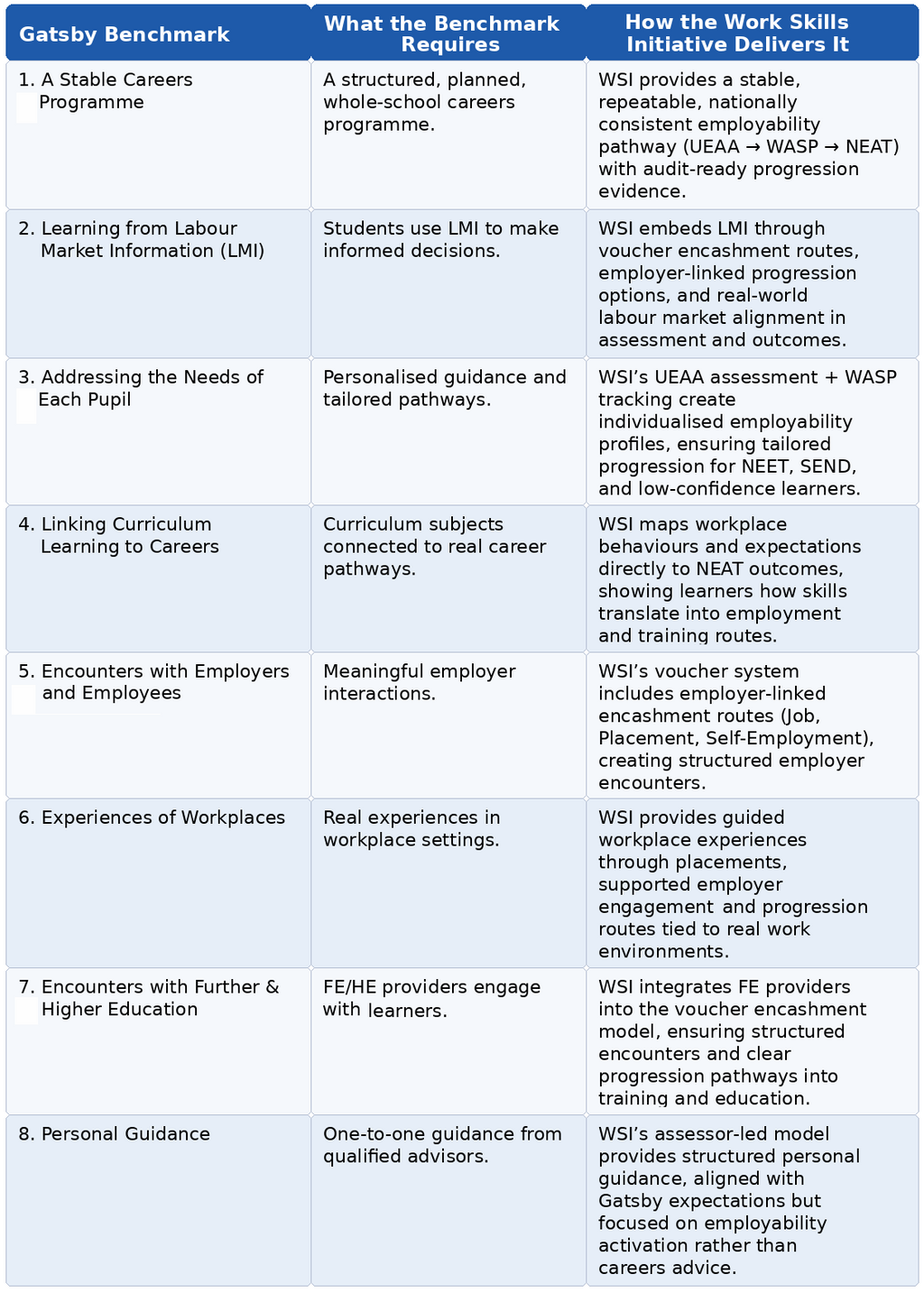
The Work Skills Initiative (WSI) provides the practical engine that enables organisations to deliver the Gatsby Benchmarks in a structured, measurable and auditable way. While Gatsby sets out what good careers education should include, WSI supplies the how: a coherent operational model built around UEA, WASP and NEAT. This pathway ensures that employability development is not only embedded within provision but evidenced through assessment, activation and progression tracking.
Each Gatsby Benchmark finds a natural counterpart within WSI’s processes. Employer encounters, workplace experiences and FE/HE engagement are strengthened through WSI’s voucher‑based progression routes, which convert these activities into tangible learner outcomes. Personal guidance is delivered through assessor‑led activation sessions, and curriculum links are reinforced by mapping workplace behaviours and expectations directly to NEAT competencies. In this way, WSI translates Gatsby’s strategic framework into day‑to‑day delivery mechanisms that providers can implement consistently.
Crucially, WSI enhances Gatsby’s inclusivity ambitions by offering a structured model that works for NEET, SEND and low‑confidence learners who often struggle to engage with traditional careers programmes. Through clear assessment stages and supported activation, WSI ensures every learner’s journey is visible, trackable and aligned with labour‑market realities.
Together, WSI and Gatsby create a powerful combination: a national framework paired with an operational system that makes careers education meaningful, measurable and effective.
1. A Stable Careers Programme
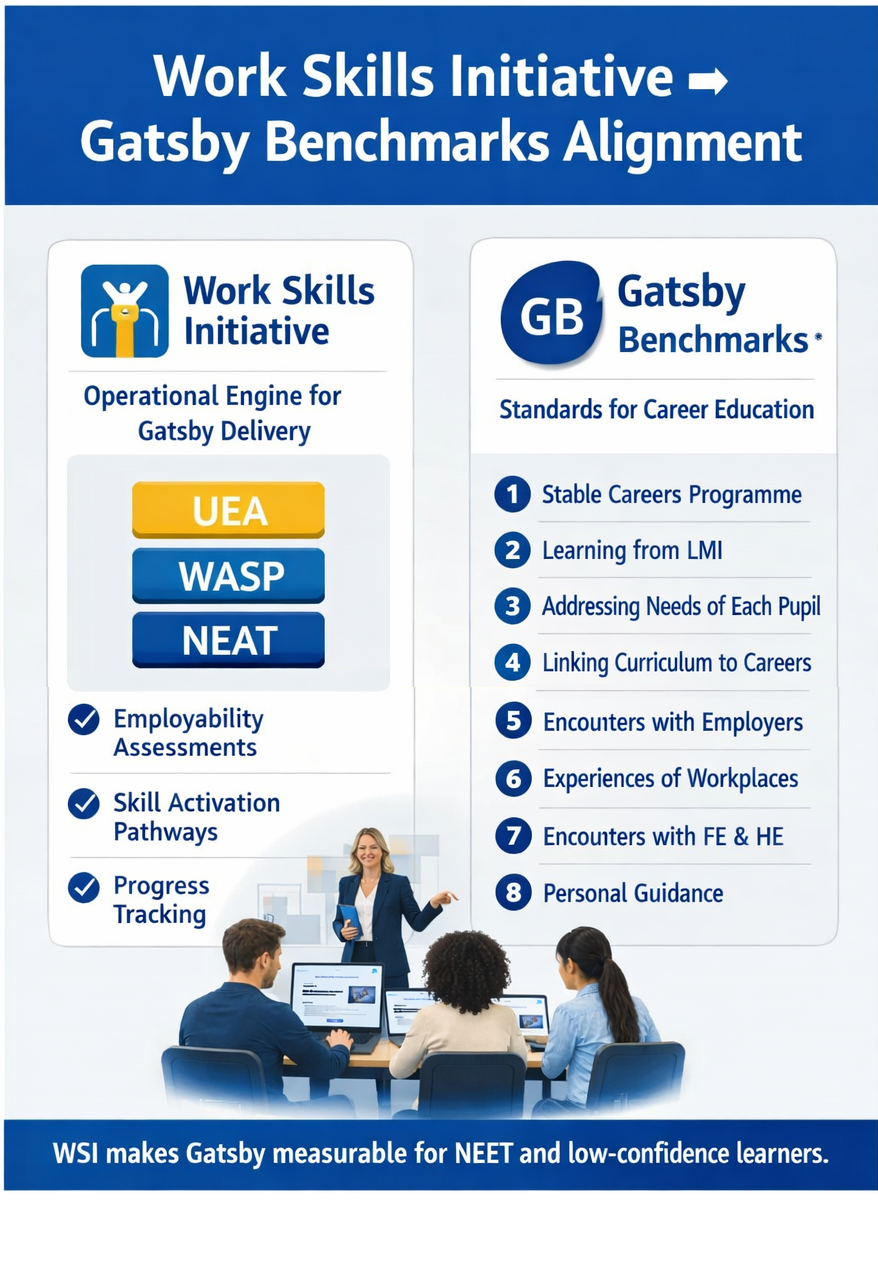
We provide a structured, repeatable assessment. Every young person gets a baseline, a score, and a plan. Hubs can track progress and prove impact.
2. Learning from Career and Labour Market Information
We assess understanding of local jobs, skills needed, and types of work. This makes LMI personal, not abstract.
3. Addressing the Needs of Each Young Person
70+ touchpoints. Adaptability, teamwork, communication, confidence, digital, integration. RAG scored by a trained assessor. Bespoke support, not generic content.
4. Linking Curriculum to Careers
We identify the exact skills, qualifications, and experience for a target job. Schools and colleges can use this to make lessons real.
5. Encounters with Employers
We build interview skills, customer service, networking, and cold-calling confidence first. So, employer time is not wasted.
6. Experiences of Workplaces
We check readiness: reliability, deadlines, initiative, workplace conduct. We only refer young people who are ready to succeed.
7. Encounters with Further and Higher Education
We explore qualifications needed and plan B pathways. Young people see FE, HE, and work as real options.
8. Personal Guidance
This is personal guidance. One-to-one. Human. Every young person leaves with clarity on next steps before any funding is committed.
Beyond Gatsby
The UEA Readiness Check gives Careers Hubs a way to understand a young person’s real level of employability readiness before committing them to high‑intensity provision. Every young person is different, and automated systems cannot reliably distinguish between disengagement, confusion, anxiety or genuine readiness. A structured, human‑led readiness check can. It provides an eight‑domain assessment that identifies whether a young person is prepared to benefit from further support — ensuring that investment is targeted where it will actually make a difference.
This matters because thousands of young people leave school each year with no confirmed destination. When they are not tracked, they are not supported — and when they are not supported, they disengage and drift into NEET status. That drift is what creates the later financial pressure on councils, colleges and national programmes. A readiness check prevents that drift by intervening before a young person disappears from the system.
If a young person doesn’t log in, automated platforms simply record non‑engagement and move on. The readiness‑check model does the opposite: it treats non‑engagement as a signal to act. Hubs, colleges, Jobcentre Plus teams and community partners reach out directly, meeting young people where they are. The hardest‑to‑reach young people rarely click a link — but they will talk to someone who shows up.
Platforms measure engagement. WSI creates it. Non‑login isn’t a failure; it’s an early warning — and an opportunity to prevent a young person from becoming another “unknown destination” statistic.